 English
 Indonesia
Graduate Learning Outcomes (CPL)
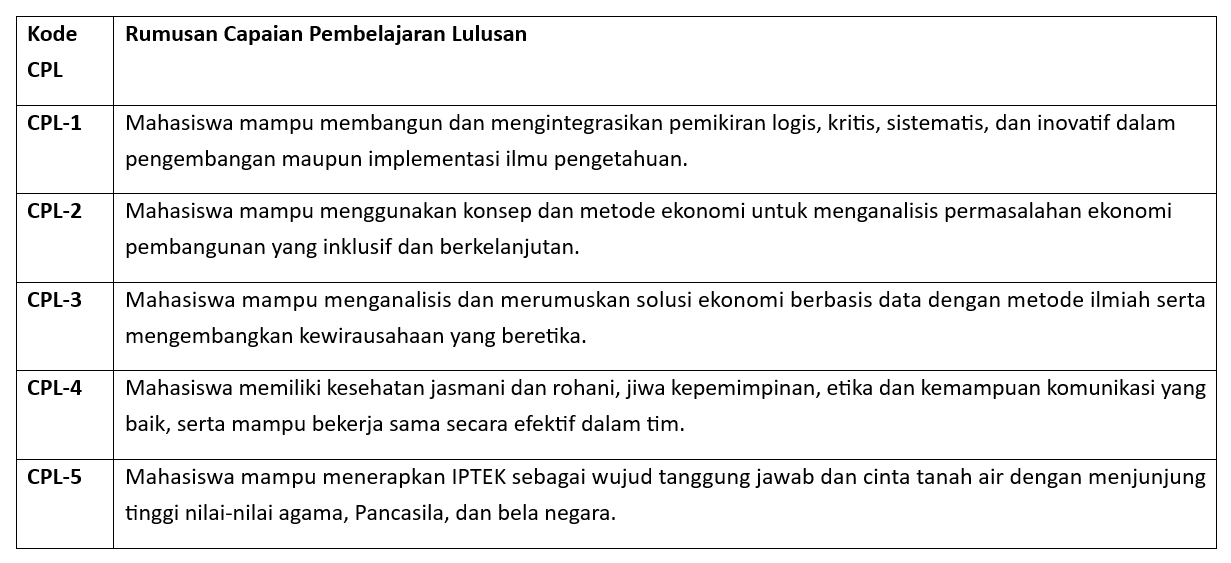
The Graduate Learning Outcomes (CPL) of the Development Economics Study Program are designed to equip graduates with academic, professional, and social competencies that enable them to analyze and formulate solutions to development economics problems at various levels. The CPL includes data, technology, and humanities literacy; communication skills; collaboration; critical and creative thinking; data-driven decision-making; as well as ethics and social responsibility. It also incorporates additional competencies through the Merdeka Belajar Kampus Merdeka (MBKM) program, ensuring graduates are adaptive, sustainability-oriented, and prepared to contribute to local, national, and global society.
The CPL achievement scoring rubric is developed as a general reference for assessing the level of graduate learning outcome attainment for each CPL. A score of 4 indicates excellent achievement, a score of 3 indicates good achievement, a score of 2 indicates fair achievement, and a score of 1 indicates poor achievement. This rubric serves as a basis for developing assessment instruments at the course level as well as evaluating CPL achievement at the study program level.
Score Category Description:
| CPL | Assessment Techniques | Assessment Instruments | Scoring Criteria |
|---|---|---|---|
| CPL 1 Students can build and integrate logical, critical, systematic, and innovative thinking in the context of developing or applying knowledge in economics. | Written tests, analytical assignments, case studies, presentations, projects, and final thesis | Essay questions, analytical rubrics, presentation rubrics, project rubrics, and thesis rubrics | 4 = highly able to demonstrate integrated logical, critical, systematic, and innovative thinking; 3 = able to demonstrate well but not yet in-depth; 2 = moderately able but still limited; 1 = not yet able adequately. |
| CPL 2 Students can use economic concepts and methods to analyze development economics problems inclusively and sustainably. | Written exams, economic analysis tasks, case studies, policy briefs, group projects, and presentations | Exam questions, economic analysis rubrics, policy brief rubrics, project rubrics, and presentation assessment sheets | 4 = highly able to apply concepts and methods accurately and comprehensively; 3 = able but not yet fully comprehensive; 2 = moderately able but limited; 1 = not yet able appropriately. |
| CPL 3 Students can analyze and formulate data-based economic solutions using scientific methods and develop ethical entrepreneurship. | Practicum, data processing, research proposals, mini research, research reports, business plans, feasibility studies, and presentations | Data analysis rubrics, practicum worksheets, proposal rubrics, research report rubrics, business plan rubrics, and presentation rubrics | 4 = highly able to analyze data, apply scientific methods, and demonstrate ethical entrepreneurship; 3 = able to perform well; 2 = moderately able but limited; 1 = not yet able to perform adequately. |
| CPL 4 Students possess physical and mental well-being, leadership spirit, good ethics and communication skills, and teamwork ability. | Observation, process assessment, group assignments, presentations, peer assessment, class participation, internships, and collaborative projects | Behavioral observation sheets, teamwork rubrics, leadership rubrics, communication rubrics, peer assessment tools, and reflection journals | 4 = consistently demonstrates all competencies very well; 3 = demonstrates well; 2 = moderately able but not consistent; 1 = not yet able adequately. |
| CPL 5 Students can apply science and technology responsibly as a form of patriotism and love for the nation while upholding religious values, Pancasila, and national defense values. | Observation, reflective assignments, case studies, community service projects, presentations, process evaluation, and co-curricular activities | Behavioral observation sheets, case study rubrics, project rubrics, presentation rubrics, reflection journals, and activity portfolios | 4 = highly able to apply science and technology responsibly and consistently with national values; 3 = able to apply well; 2 = moderately able but not consistent; 1 = not yet able adequately. |